
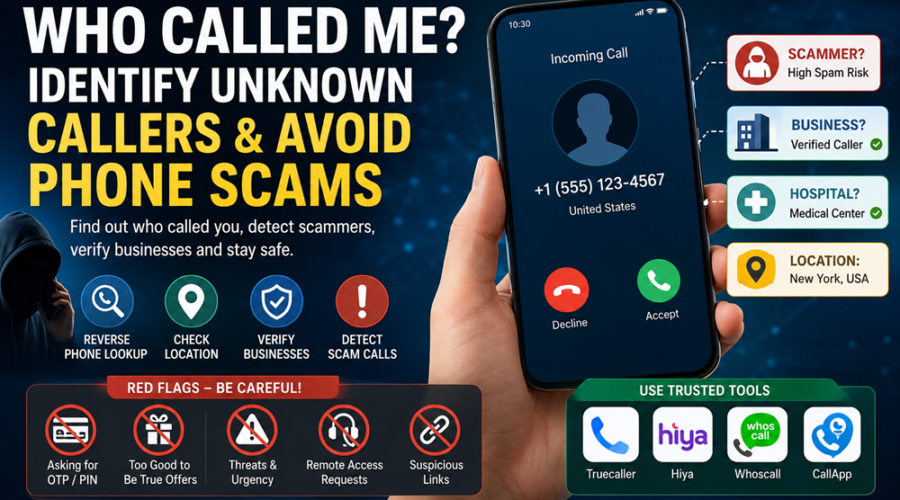
How to Identify Unknown Callers & Avoid Phone Scams in 2026
How to Understand Who Called You: Scammers, Organizations, Medical Institutions, or Someone Else
Every day, millions of people receive calls from unknown numbers. Some are legitimate calls from businesses, hospitals, delivery services, banks, or government offices. Others may be telemarketers, scammers, robocalls, or fraudsters attempting to steal personal information.
Knowing who called you can help you avoid scams, protect your privacy, and decide whether the call deserves a callback. In this guide, you’ll learn how to identify unknown callers, determine the region from which a call originated, use reverse phone lookup tools, and stay safe from phone scams.
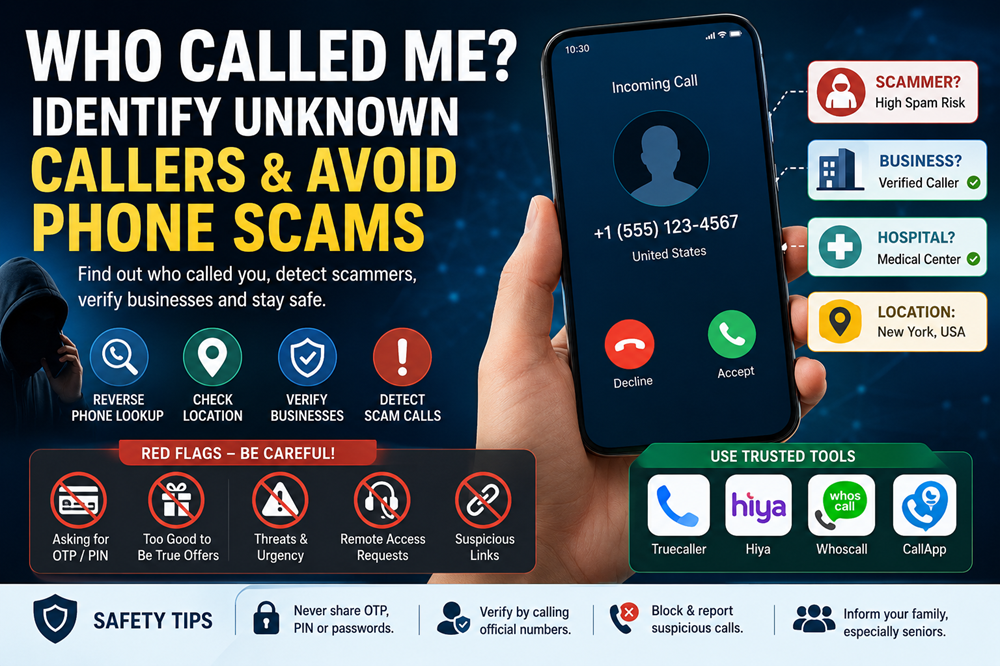
Who Called Me? Identify Unknown Numbers & Spot Scammers
Received a call from an unknown number? Learn how to find out who called, identify scammers, check locations, and stay safe from phone fraud.
in this blog you can find in detail:
- identify unknown callers
- phone scams
- reverse phone lookup
- Truecaller
- phone fraud
- who called me
- unknown number lookup
Why Identifying Unknown Callers Matters
Unknown calls can come from various sources:
- Family members or friends using a new number
- Businesses and customer service departments
- Medical institutions and hospitals
- Schools and universities
- Delivery companies
- Government agencies
- Telemarketing companies
- Scammers and fraudsters
Understanding who is calling helps you:
- Avoid fraud and identity theft
- Protect personal information
- Block spam and robocalls
- Reconnect with legitimate contacts
- Report suspicious activity
How to Determine the Region of a Phone Number
One of the first clues about a caller is the phone number’s area code or country code.
International Country Codes
Examples:
| Country | Code |
|---|---|
| United States/Canada | +1 |
| United Kingdom | +44 |
| India | +91 |
| Australia | +61 |
| Germany | +49 |
If a number begins with an unfamiliar international code, search the code online to identify the country.
Area Codes
For landlines and many business numbers, area codes often reveal:
- State
- City
- Region
Example:
- 212 → New York City
- 020 → London
- 011 → Delhi (older landline format)
However, mobile numbers and VoIP services may not accurately reflect a person’s current location.
Search the Number on Search Engines
Before using specialized tools, simply search the number online.
Google Search
Type the full number including:
- Country code
- Area code
Example:
+91 9876543210or
9876543210You may discover:
- Business listings
- Company websites
- Public directories
- Customer reviews
- Scam reports
The same method works with search engines like:
Use Reverse Phone Lookup Services
Reverse phone lookup services collect publicly available information and user reports to help identify unknown callers.
Popular Reverse Lookup Websites
- Truecaller
- Whitepages
- Spy Dialer
- WhoCallsMe
- Tellows
These services may provide:
- Caller name
- Business information
- Location
- Spam score
- User comments
- Scam reports
Remember that information quality varies depending on the country and number type.
Identify Calls from Medical Institutions
Hospitals, clinics, and laboratories often call patients for:
- Appointment reminders
- Test results
- Prescription updates
- Insurance verification
Signs the call may be from a medical institution:
- Number appears on the hospital’s official website
- Caller references a recent appointment
- Caller identifies the clinic or doctor
Verify Safely
Instead of providing personal details:
- Hang up politely.
- Find the hospital’s official number.
- Call back through official channels.
Never trust a caller solely because they know basic information about you.
Recognizing Calls from Organizations and Businesses
Businesses often contact customers regarding:
- Deliveries
- Support tickets
- Banking alerts
- Account verification
Before sharing information:
Verify
- Search the number online.
- Visit the organization’s official website.
- Call the published customer service number.
Legitimate companies generally do not ask for:
- Banking passwords
- OTP codes
- Full card PINs
- Security codes
Common Phone Scams to Watch Out For
1. Bank Account Scam
The caller claims:
“Your account has been suspended.”
They ask for:
- OTPs
- PINs
- Passwords
Legitimate banks never ask for these details over the phone.
2. Tech Support Scam
The caller claims:
“Your computer has a virus.”
They may request:
- Remote access
- Software installation
- Payment for fake services
3. Government Impersonation Scam
Scammers pretend to represent:
- Tax agencies
- Police departments
- Immigration authorities
They often create urgency and threaten penalties.
4. Prize or Lottery Scam
The caller claims:
“You won a prize.”
Then requests:
- Fees
- Taxes
- Banking information
Legitimate lotteries do not require upfront payment.
5. Delivery Scam
The caller claims a package cannot be delivered unless you:
- Click a link
- Pay a fee
- Verify financial details
Always verify directly with the delivery company.
Best Apps for Identifying Unknown Callers
Truecaller
Truecaller Official Website
Features:
- Caller identification
- Spam detection
- Community reports
- Call blocking
Hiya
Hiya Official Website
Features:
- Spam alerts
- Caller identification
- Fraud protection
CallApp
CallApp Official Website
Features:
- Reverse lookup
- Spam filtering
- Caller information
Whoscall
Whoscall Official Website
Features:
- Offline caller database
- Spam detection
- Business identification
What to Do If You Suspect a Scam
Do Not
❌ Share OTPs
❌ Share passwords
❌ Share banking PINs
❌ Install unknown software
❌ Click suspicious links
Do
✅ Hang up immediately
✅ Block the number
✅ Report the caller
✅ Contact the organization directly
✅ Inform family members
How to Block Unwanted Calls
Android
- Open Phone App
- Select Recent Calls
- Tap the number
- Choose “Block”
iPhone
- Open Phone App
- Recent Calls
- Tap the information icon
- Select “Block Caller”
You can also use spam-filtering apps for additional protection.
Reporting Scam Calls
Depending on your country, you can report suspicious calls to:
- Consumer protection agencies
- Telecommunications regulators
- Local police
- Cybercrime reporting portals
Reporting helps authorities identify large-scale fraud operations.
Privacy Tips When Investigating Unknown Numbers
Even when researching a caller:
- Avoid harassment or repeated calling.
- Use public information only.
- Respect privacy laws.
- Do not publish personal details online.
- Verify information through multiple sources.
Real-Life Scam Call Examples (Conversation Demos)
Example 1: Fake Bank Verification Scam
Scammer:
“Hello Sir, I’m calling from XYZ Bank’s fraud department. Your account may be blocked in the next 30 minutes.”
Victim:
“What happened?”
Scammer:
“We detected suspicious activity. Please confirm the OTP we are sending.”
Victim:
“Okay.”
Scammer:
“Tell me the OTP immediately so we can secure your account.”
🚨 Red Flag: Banks never ask for OTPs, PINs, passwords, or CVV numbers.
Example 2: Hospital Appointment Scam
Scammer:
“You have a medical test scheduled tomorrow. Please verify your Aadhaar and bank details.”
Victim:
“I don’t remember booking anything.”
Scammer:
“It was booked through insurance. Please verify quickly.”
🚨 Red Flag: Creating confusion and urgency.
Example 3: Delivery Package Scam
Scammer:
“Your package is stuck at customs. Pay ₹99 immediately.”
Victim:
“Which package?”
Scammer:
“We can’t disclose details until payment.”
🚨 Red Flag: Legitimate couriers usually provide tracking information and official communication channels.
The Psychology of Scammers
One of the most valuable sections you can add.
Scammers rarely hack people-they manipulate them.
Common psychological techniques include:
Fear
“Your bank account will be frozen.”
Urgency
“You must act within 15 minutes.”
Authority
“I’m calling from the police department.”
Greed
“You won ₹5 lakh.”
Sympathy
“My child is in the hospital.”
Social Proof
“Thousands of customers have already completed verification.”
These tactics align closely with well-known persuasion principles studied by Robert Cialdini and are commonly seen in modern fraud schemes.
Why Truecaller Names Change Frequently
Many readers ask this question.
Reason 1: Community Reports
Apps like Truecaller use community data and user reports to identify numbers. If many users save or report a number differently, the displayed name may change over time.
Reason 2: User Profile Updates
Users can modify their own profile names, affecting what appears to others.
Reason 3: Number Recycling
Telecom companies often reassign old numbers to new customers. The displayed name may belong to a previous owner.
Important Note
Never trust a caller simply because a name appears on your screen. Scammers frequently exploit this trust.
Understanding Truecaller Colors and Symbols
Many users search for this.
| Color/Symbol | Meaning |
|---|---|
| Red | Frequently reported spam |
| Green Check | Verified business |
| Magnifying Glass | Number searched manually |
| Phone Symbol | Identified Truecaller user |
These visual indicators help users quickly evaluate incoming calls.
Most Common Warning Signs of Scam Calls
Create a checklist.
Hang Up Immediately If:
- They ask for OTP
- They ask for passwords
- They demand immediate payment
- They threaten arrest
- They ask you to install software
- They request remote access to your phone
- They ask for gift cards or vouchers
- They pressure you not to tell anyone
Scammer Script Breakdown
Many scam calls follow the same pattern:
Stage 1 – Introduction
“Hello, this is Rahul from your bank.”
Stage 2 – Create Fear
“We detected suspicious activity.”
3 Stage – Increase Urgency
“Action is required immediately.”
Stage 4 – Request Information
“Please confirm your OTP.”
Stage 5 – Complete Fraud
Money or account access is stolen.
Research on scam calls has identified repeated scripted stages and emotional manipulation patterns used by fraudsters.
Apps Worth Mentioning
Caller Identification
- Truecaller
- Hiya
- Whoscall
- CallApp
Security Apps
- Microsoft Defender
- Malwarebytes
Books About Scammer Psychology
Influence: The Psychology of Persuasion
Learn:
- Authority
- Reciprocity
- Scarcity
- Social proof
- Persuasion techniques
Widely regarded as a foundational book for understanding influence and persuasion.
Scam Me If You Can
Scam Me If You Can by Frank Abagnale
Focuses on modern fraud tactics and personal protection.
The Confidence Game
Explains why intelligent people fall for scams.
Countries and Regions Frequently Associated with Scam Operations
Be careful not to imply that everyone from a region is involved in fraud.
Instead write:
Scam operations have been uncovered in many countries worldwide. Fraud can originate from anywhere because scammers use internet calling, spoofed numbers, and virtual phone systems. The displayed number often does not reveal the scammer’s actual location.
Examples of commonly reported scam categories include:
- Tech support scams
- Investment scams
- Romance scams
- Call-center fraud
- Government impersonation scams
The key point: Judge behavior, not location.
Future of Caller Identification
Interesting 2026 addition.
In India, telecom operators have begun rolling out Calling Name Presentation (CNAP), which displays registered caller names directly through telecom networks rather than relying only on third-party apps. This aims to improve caller transparency, though users should still remain cautious because a displayed name alone does not prove legitimacy.
FAQ
Can scammers fake phone numbers?
Yes. This is called caller ID spoofing.
Is a caller safe if Truecaller shows a name?
No. Names can be outdated, community-generated, or misleading. Always verify independently.
Can I identify every phone number online?
No. Mobile numbers are often private and may not appear in public databases.
Should I call unknown numbers back?
Only if you have reason to believe the call is legitimate.
What if I accidentally shared an OTP?
Contact your bank or service provider immediately.
Why do smart people fall for scams?
Because scammers exploit emotions such as fear, urgency, trust, and authority rather than intelligence.
Final Thoughts
Receiving calls from unknown numbers can be frustrating, but modern tools make it easier than ever to identify callers. By checking area codes, searching online, using reverse phone lookup services, and relying on caller identification apps, you can often determine whether a call came from a legitimate organization, medical institution, business, or potential scammer.
The most important rule is simple: Never share sensitive information over the phone unless you independently verify who is calling. A few minutes of verification can prevent financial loss, identity theft, and other forms of fraud.
also Read…
- Top 20 Most Common Scam Call Phrases
- How to Check if a Phone Number Is Safe
- Reverse Phone Lookup: Complete Beginner’s Guide
- How Scammers Use AI Voice Cloning
- 10 Signs an Unknown Caller Is Legitimate
- What to Do Within the First 10 Minutes After a Scam Call
- Phone Scam Statistics (Latest Year)
- How Senior Citizens Are Targeted by Phone Scammers
- How to Protect Your Parents From Scam Calls
Stay Safe and Stay Informed
Phone scams continue to evolve every year. The best defense is awareness, verification, and caution before sharing any personal information.
For more business guides, digital growth resources, marketing insights, and business directory listings, visit VyaparGrow.com and explore our growing collection of educational content.
Own a Business?
Help customers recognize and trust your brand online.
List Your Business on VyaparGrow.com